Peptide testing: what a lab test proves and how to read the certificate
A peptide test is a lab's check on one vial. It can show which compound is inside, how pure it is and how much is there. Below: each test in plain words, a real lab certificate read field by field, how to get a vial tested and what it costs.
- IdentityIs it the right peptide?A mass spectrometer weighs the molecule.
- PurityHow pure is it?A method called HPLC splits the sample into its parts.
- AmountHow many mg are inside?Measured against a known standard.
In this guide
What is peptide testing?
Peptide testing means sending a vial to a lab and asking what is really in it. Most peptides sold online come as a white powder in a small glass vial. You can't tell by eye which compound it is, how pure it is, or how much is there. The label is the seller's claim. A lab test checks that claim on one vial.
People test to check three things: that the vial holds the compound on the label, how many milligrams (mg) are inside, and that nothing unwanted came with it, such as toxins from bacteria.
A seller's own lab report may not answer these questions for the vial you hold. It may be for another batch (another production run), or it may be old. In our study of lab certificates posted by sellers, 19.5% of the 15,693 that carry a date were more than a year old when we downloaded them.
What a lab does with a vial
It logs the vial
The lab records who sent the vial and gives it a sample number. Some labs also take a photo. The form that travels with the vial is called a chain of custody.
It dissolves the powder
A technician dissolves the powder in a measured amount of liquid. A tiny, known part of that liquid goes into the instrument.
It splits the sample into its parts
HPLC (high-performance liquid chromatography) pushes the liquid through a narrow column. Each substance comes out at its own time and draws a peak on a chart. The tall peak is the compound. Its share of the total peak area is the purity.
It weighs the molecules
A mass spectrometer measures the mass of the molecules. Every peptide has a known mass. If the mass found matches, the lab reports the identity as confirmed.
It measures the amount
The lab runs a known amount of the same compound, called a reference standard, and compares the two peaks. That gives the mg in your vial.
It writes the report
The results go into a certificate of analysis, or COA. It is usually a PDF.
Peptide purity, identity and amount: what each test proves
There are six main tests. Each answers a different question, and no single test answers them all. Some labs include several in one price. Others sell them as extras.
| Test | What it tells you | What it does not tell you |
|---|---|---|
| Purity, by HPLCThe peptide purity test | How much of what the detector sees is the main compound, as a percent. At 99%, the main peak makes up 99% of the total peak area. | Which compound it is, or how many mg are in the vial. Water and leftover salt are not counted in the percent, so 99% pure does not mean 99% of the powder is peptide. |
| Identity, by mass specAlso written MS or LC-MS | Whether the compound on the label is in the vial. The lab compares the mass it finds with the known mass of that compound. | How pure the sample is, or how much is in the vial. It also can't tell apart two molecules with exactly the same mass. |
| Amount in the vialAlso called net peptide content, quantity, assay or potency | How many mg of the compound are in the vial, and what share of the label amount that is. | Anything about other vials, because fill can differ from one to the next. It also can't say whether the label counts all the powder or only the peptide. Powder holds some water and salt too. |
| EndotoxinOften called a LAL test. Results are in EU, endotoxin units | How much endotoxin is in the sample. Endotoxins are parts of the outer wall of some bacteria. They can stay behind after the bacteria are dead. | That the sample is sterile. Living bacteria and fungi need their own test. |
| SterilityThe full test takes at least 14 days | Whether bacteria or fungi grow from the sample. The lab puts it in a liquid that feeds microbes, then waits and watches. | Anything about endotoxin, purity or amount. A pass covers the vials tested. It can't clear a whole batch. |
| Heavy metalsUsually by a method called ICP-MS | How much lead, arsenic, cadmium and mercury the sample holds. | Anything about the peptide itself, or about microbes. |
Most seller certificates show purity and little else. In our study of 18,699 certificates, 62.9% showed purity and nothing else. At least 33.9% showed a contamination test: at least 28.4% endotoxin, 16.4% sterility or a microbe count, and 14.4% heavy metals. Read the certificate study.
Purity alone can mislead. We bought a 5 mg BPC-157 vial as a normal customer and had it tested. It was above 99.9% pure. But the lab measured 3.52 mg of BPC-157 in it, which is 70.4% of the label.
What is a COA? A real certificate, field by field
COA stands for certificate of analysis. It is the report a lab writes after it tests a sample. It says who tested the sample, for whom, when, by which method, and what the lab found.
A COA covers the sample the lab received. It speaks for a whole batch only if that sample really came from the batch. So the first job is to read who sent it and what was sent.
The certificate below is real. Krause Analytical in Austin, Texas issued it on 18 November 2026 for the BPC-157 vial from the test above. The pictures are cut from the lab's report. We changed nothing in them, apart from one grey box over the photo of the vial. See the full test and the lab's PDF.
The top of the page: who sent it, which lab, and when
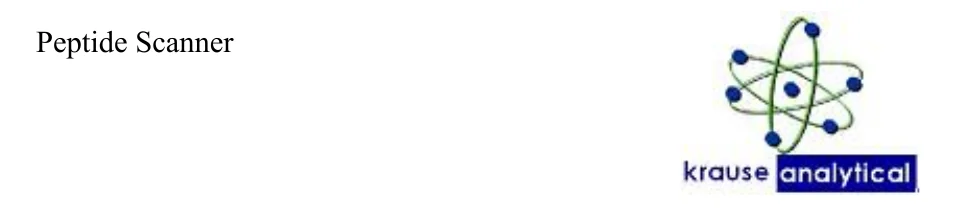
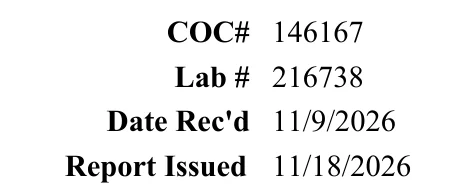
- 1
Client
Printed on this report: Peptide ScannerWho sent the sample and paid for the test. On a seller's COA this should be the seller. If it names another company, the report may belong to someone else. A testing service that orders for you, such as ours, appears as the client instead.
- 2
Lab
Printed on this report: Krause AnalyticalThe lab that ran the test. It should be a lab you can find and contact yourself, and a separate company from the seller.
- 3
Report numbers
Printed on this report: COC# 146167, Lab # 216738The lab's own numbers for this sample. COC means chain of custody, the form that came with the vial. You quote these numbers when you ask the lab about a report. Other labs print a task number, a key or a QR code here.
- 4
Dates
Printed on this report: Date Rec'd 11/9/2026, Report Issued 11/18/2026When the lab got the vial and when it issued the report. US labs write the month first, so these are 9 and 18 November. An old report says little about the batch on sale today.
The middle: what was tested
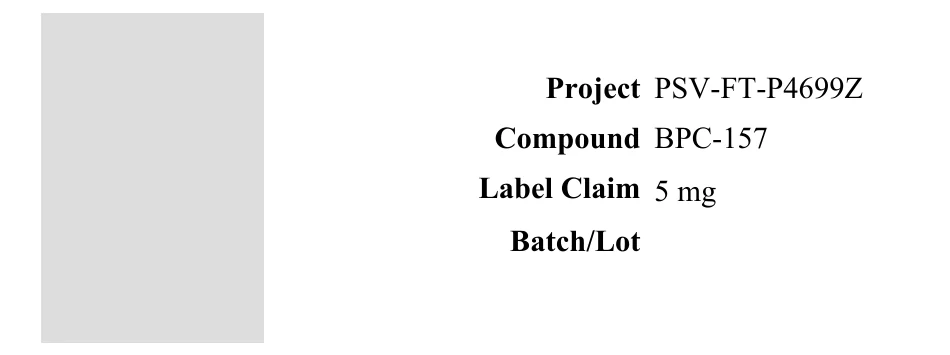
- 5
Photo of the vial
Printed on this report: Photo, covered by usThe lab photographed the vial it received. We covered the photo here. On your own report, check it shows the product and strength you expect. Some labs add no photo.
- 6
Project
Printed on this report: PSV-FT-P4699ZThe client's own reference for the sample. Here it is our reference for this order.
- 7
Compound
Printed on this report: BPC-157What the client says is in the vial. The lab looks for this compound and no other. If the name is wrong, the result comes back as not detected.
- 8
Label claim
Printed on this report: 5 mgThe amount printed on the vial. The lab compares what it measures with this number.
- 9
Batch or lot
Printed on this report: BlankThe batch number of the vial. It is blank on this report. On a seller's COA it should match the batch you bought, because a result only speaks for the batch that was tested.
The results table

- 10
Chromatographic purity
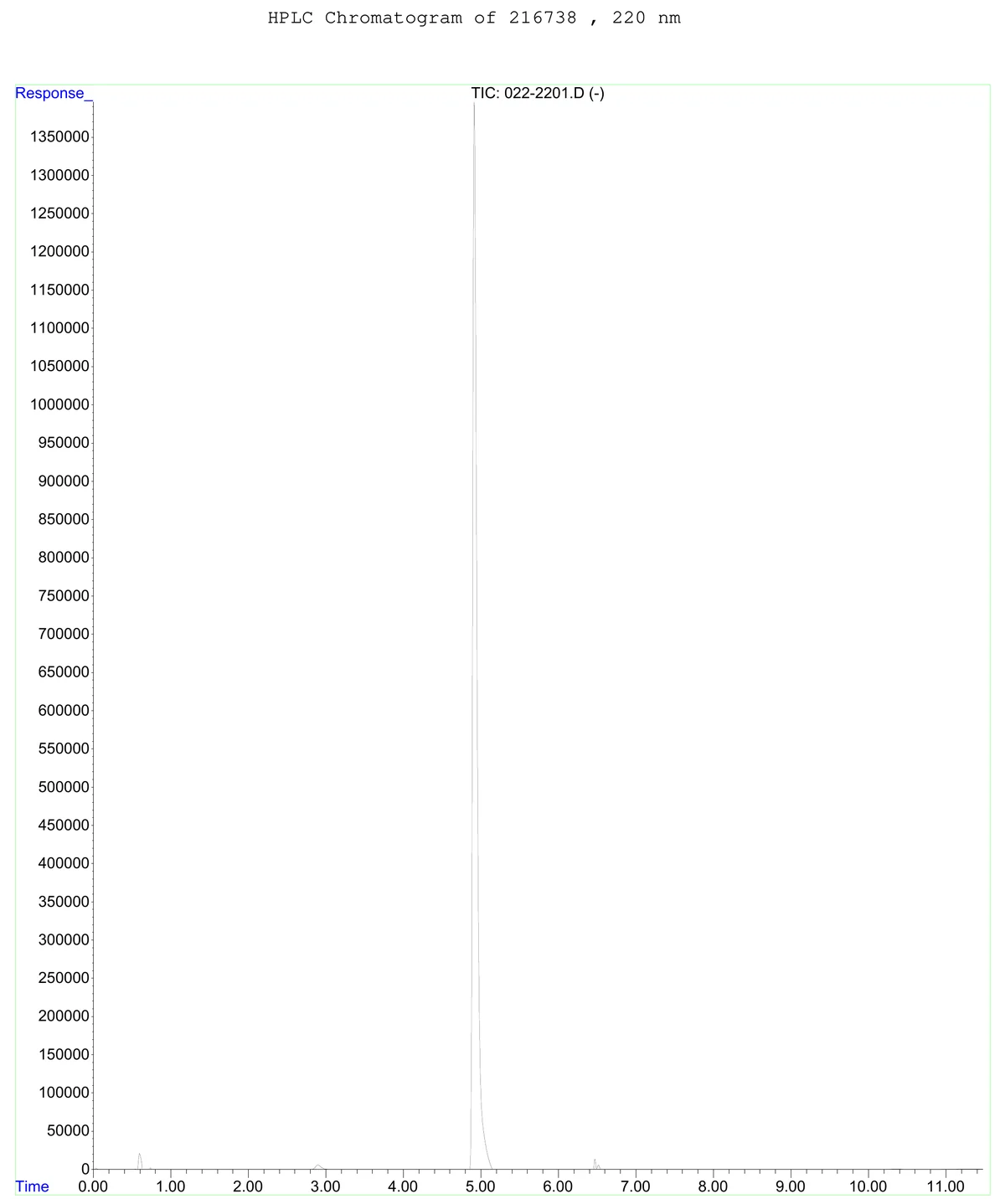
Printed on this report: >99.9 %The HPLC purity. More than 99.9% of what the detector saw was the main compound.
- 11
Amount, and percent of label
Printed on this report: 3.52 mg, 70.4 % of labelThe mg of BPC-157 the lab measured in the vial, and that amount as a share of the 5 mg label claim. The lab measures the peptide itself. The report does not say whether the label counts all the powder or only the peptide. Krause Analytical treats a result within 20% of the label, up or down, as within what it can measure in one run. 70.4% is outside that range.
- 12
Mass spectral match
Printed on this report: ID ConfirmedThe identity check. The mass spectrum of the sample matched the lab's BPC-157 reference.
- 13
LOQ
Printed on this report: 1 for purity (%), .1 for the amount (mg)Limit of quantification: the smallest amount the method can measure reliably. Here, an amount under 0.1 mg would be reported as below the limit instead of as a number.
- 14
Method
Printed on this report: HPLC-UV-MSHow each result was measured. This is HPLC with a UV light detector and a mass spectrometer. A result with no method named is hard to judge.
- 15
Test date
Printed on this report: 11/13/2026The day the lab ran each test. It should fall between the day the vial arrived and the day the report was issued.
- 16
CAS
Printed on this report: 137525-51-0A registry number for the chemical. It shows exactly which compound the lab was looking for.
Below the table, the page ends with the lab director's signature and the lab's address. We left both out of the pictures. Many labs also print a code or QR code there for checking the report online. This report has none.
The graphs behind the numbers
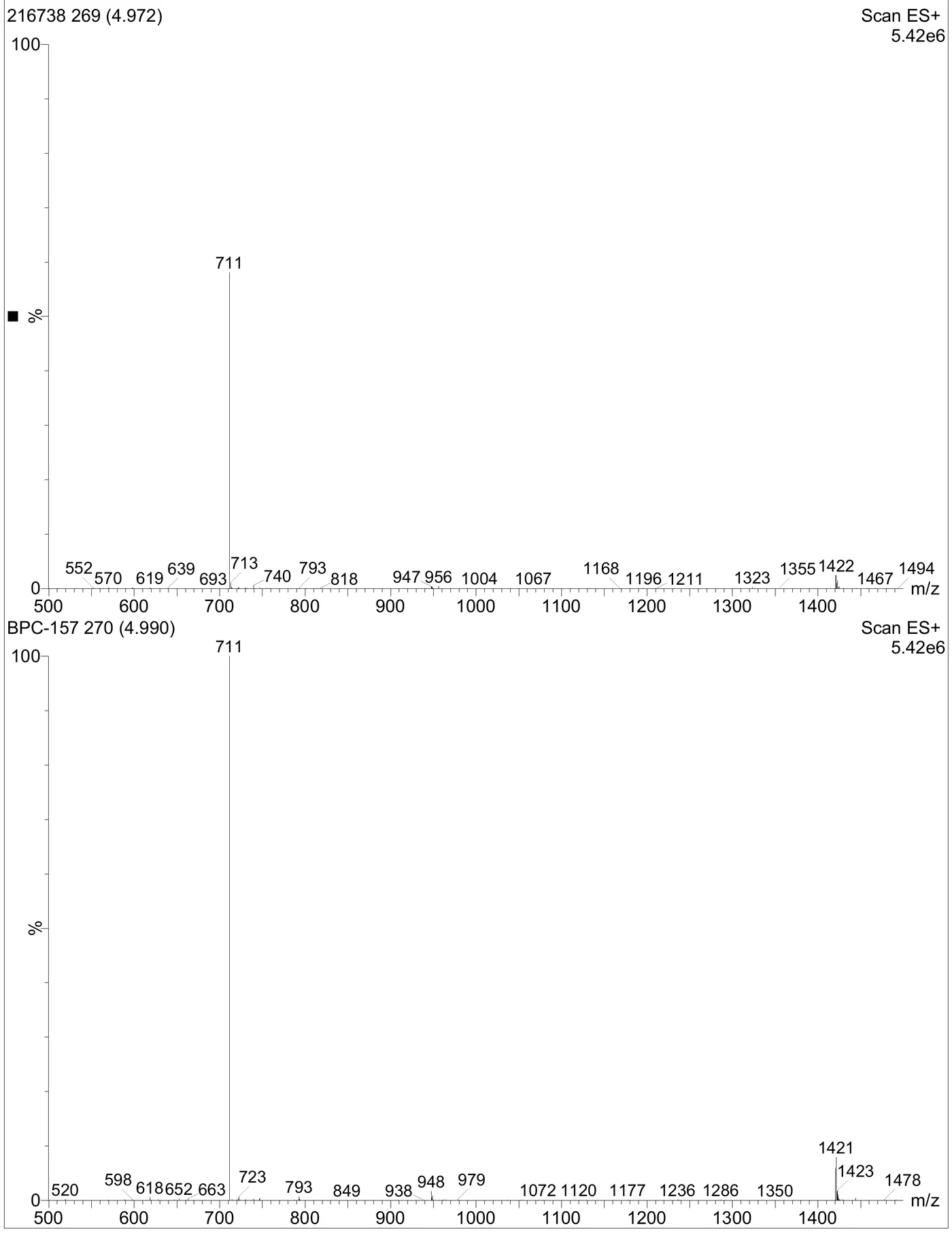
The purity and the identity result come from the two graphs on pages 2 and 3 of the report. A report that includes its graphs lets you see the raw result behind the summary.
BPC-157 weighs about 1,419. A mass spectrometer reads weight divided by charge. In this test most molecules picked up two hydrogen ions, which gave them two charges, so the main line is at (1,419 + 2) ÷ 2, about 711. The small line just above 1,420 is the same molecule with one charge. The sample and the lab's reference show both lines in the same places.
What this certificate does not tell you
- It covers this one vial. Another vial or another batch can be different.
- It did not test for endotoxins, sterility or heavy metals.
- The batch line is blank, so the report alone can't be tied to a batch.
- There is no pass or fail line. You compare the numbers with the label yourself.
- It has no code to look up online. Krause Analytical checks a certificate by email, through an upload form on its website.
A report from our $99 test comes from the same lab in the same layout. Our sample report shows it with made-up numbers. Open the sample report (PDF).
Checking a COA with the lab: what a match looks like
A PDF is easy to change. The lab's own record is much harder to change. Many labs let anyone look up a report on their website, with a number or code printed on the certificate. This check takes a few minutes and costs nothing.
The three steps are in the next section. First, here is a check where everything matched.
A worked example
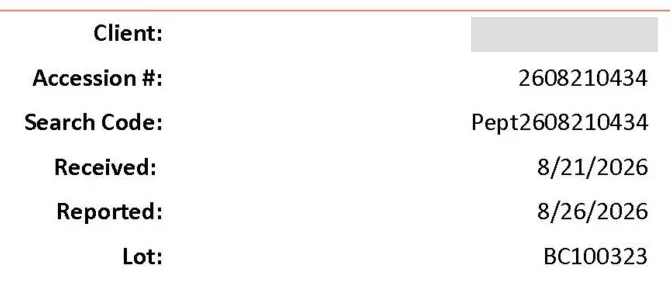
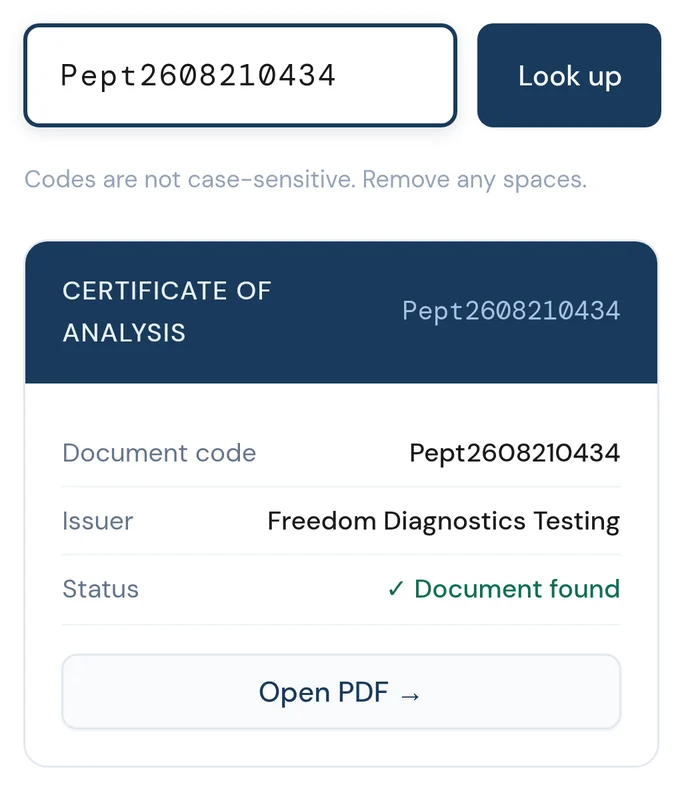
This BPC-157 certificate comes from a shop's website. Freedom Diagnostics issued it. On 22 November 2026 we typed its search code into the lab's own lookup page, and the lab found the document.
Then we opened the lab's copy and compared ten fields with the shop's copy. They were the client, the report number, the code, the product, identity, purity, amount, lot and both dates. All ten matched.
Where to look a report up
These labs have a public lookup. Each asks for something printed on the report.
- Janoshik: the task number and the verification key
- Freedom Diagnostics: the search code
- Vanguard Laboratory: the brand, the product or the batch number
- Horizon Analytical: the report number
- Ethos Analytics: the company name and the sample ID
Some labs have no lookup. Krause Analytical, the lab behind our $99 test, checks certificates by email. You can email any lab with the report number and ask if the report is theirs. In our study, we looked up 11,231 certificates as shops posted them. We found at least 33.8% on the website of the lab that issued them. For 40%, there was nothing to look up online.
Warning signs on a peptide COA: how to check one in three steps
Check a COA in this order. Under each step is what a warning sign looked like when we ran that check on real seller reports. We do not name the sellers here, because the point is the pattern.
A warning sign is a reason to check further. It is not proof that a product is bad.
Look the report up on the lab's own lookup page
Find the lab's name and the report number or code on the certificate. Go to the lab's website yourself: type its address, or search for the lab by name. A link or QR code on a PDF can point anywhere. Then type the number or code into the lab's lookup page.
If the certificate names no lab, there is nothing to look up. Go to step 3.
The warning sign is a report the lab can't find. A shop showed a certificate as the current report for one product. On 22 November 2026 we typed its code into the lab's lookup page. The lab found no document, and the lab's web address for that PDF gave an error page. Another code from the same shop was found as normal.
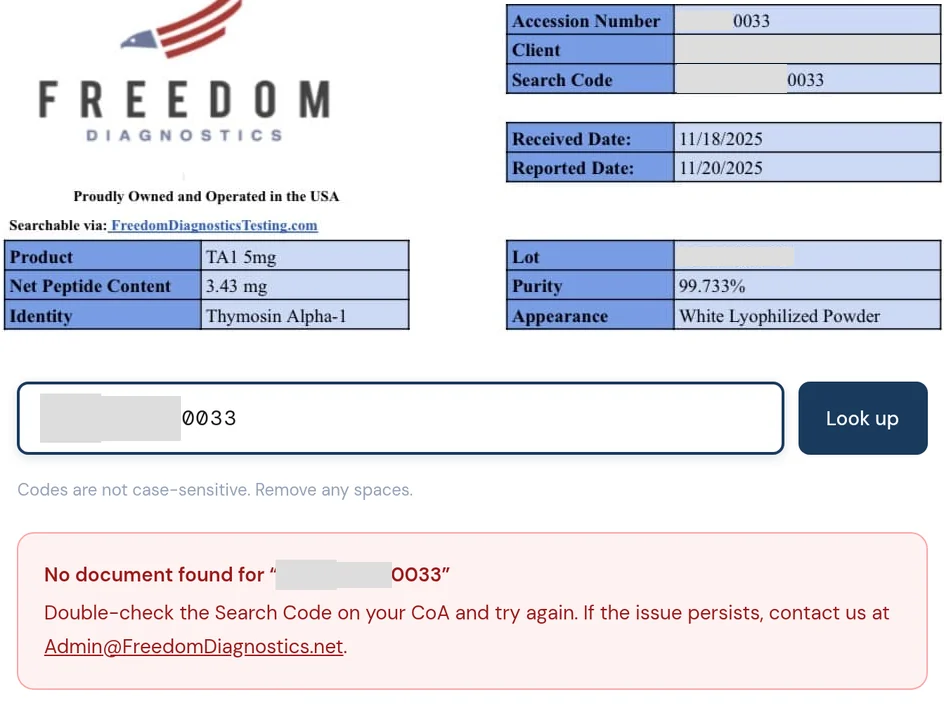
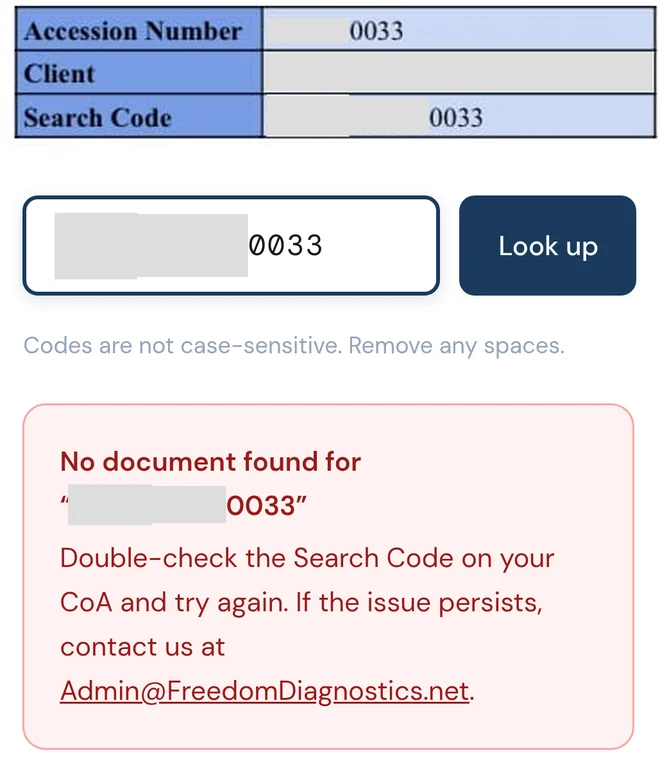
Above: the code on the shop's certificate. Below: the lab's lookup page with that code typed in. We covered the client's name, the lot and most of the code. The last four digits show it is the same code. What to do: Ask the seller which report to look up, or ask the lab. A new report may not be listed yet, so a miss on its own proves nothing. Then go to step 3.
Compare the seller's copy with the lab's copy, number by number
When the lab finds the report, open the lab's copy next to the seller's. The client, the compound, the batch, the dates, the purity and the amount should all be the same. If one number differs, the lab's record is the one to trust.
The warning sign is a number that differs. We opened every report in one shop's library next to the lab's own PDF of the same report. On 7 reports, one number was different and the rest of the page was the same. Every change made the shop's copy look better. On 6 of the 7, an amount under the label became one at or over it, or a purity under 99% became one over 99%.
Slide the picture sideways to see the dates and the purity. They are the same on both copies.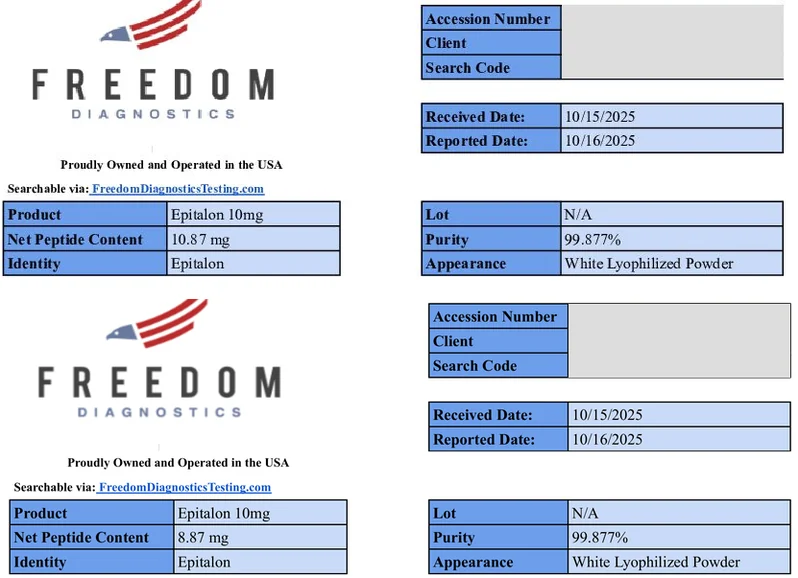
One report, two copies. First: the shop's copy, 10.87 mg. Second: the lab's own copy, 8.87 mg. We covered the report number, client and code. Most copies we could check name the same client as the lab's own copy. In our study, the client name matched on 1,133 of 1,136.
What to do: Trust the lab's copy. Then go to step 3.
If the copy does not match, or there is no lab record, check where the PDF was made
A PDF usually records the program that made it. Open the file's document properties and read two lines: Application and PDF producer. Some programs call the first line Creator.
You need a computer for this. In Chrome, open the PDF, select the three dots on the dark bar above the page, then Document properties. In Adobe Acrobat Reader, choose File, then Properties. Preview on a Mac does not show these lines, so open the PDF in Chrome or Acrobat Reader instead.
If the lines say Canva, or another design app, you are almost certainly not looking at the lab's original file.
The warning sign is a file made in a design app. On 13 October 2026 we opened a certificate from another shop in Chrome and read its document properties. It named no lab, so there was no lab record to look up. Both lines said Canva.
Our screen recording from 13 October 2026, with no sound. Both lines say Canva. We trimmed it, zoomed in and covered everything that names the shop. A design app does not prove the numbers are wrong.
What to do: Ask the seller for the lab's original file, or for a report you can look up with the lab.
We list the certificates we found for each seller, and what we could confirm with the lab. Search sellers.
How to get a peptide tested
There are four common ways. They differ in cost, in who picks the vial, and in who sees the result. In the last three, the seller does not pick the vial. That is what third-party testing should mean.
- Read the seller's own COAFree
- Most sellers post lab reports. Find the one for your product and batch, then check it with the three steps above. A useful one names the lab, the batch and the date, and reports identity and amount as well as purity.
- Limits: The seller picked the vial and paid for the test. The report may be for another batch, or it may be old.
- Join a group testShared cost
- Buyers on Reddit and other forums often pool money to test one batch, then share the report. The cost is split, and a shared result helps other buyers.
- Limits: It tells you about your vial only if everyone bought the same batch from the same seller. You also rely on the person who posts the vial and shares the report.
- Send a vial to a testing lab yourself$150 to $250 at most labs
- You pick a peptide testing lab, post the vial and get a PDF report by email. The result is about the vial you bought, and you choose the tests.
- Limits: Check what the price covers. Some labs charge extra for the amount in the vial. Some publish your result unless you opt out or pay more. Shipping is on you. Compare prices at 12 labs.
- Order our $99 testOur test$99
- You post one sealed vial to Krause Analytical, an independent lab in Austin, Texas. The test covers identity by mass spec, purity by HPLC and the amount in the vial. You get the lab's full report by email, and it is private unless you ask us to publish it.
- See how the test works
The 12 peptide testing labs in our price guide are Finnrick, Bioviridians, Chromate, TrustPointe, Kovera Labs, ILS Laboratories, Horizon Analytical, Janoshik, Freedom Diagnostics, Vanguard Laboratory, MZ Biolabs and Colmaric. Most are in the US. Janoshik is in Prague.
What to send
For our test, the lab needs three things. Other labs have their own rules, so read them before you post.
- One sealed vial that has not been opened.
- A label that shows the compound and the amount.
- The compound name exactly as it is on the label. The lab looks only for the compound you name.
In the UK, we also test a limited number of vials free at a UK university lab. We review each request by hand. That test is purity by HPLC only, and every result is published. How free testing works.
How much does peptide testing cost?
For one common peptide, such as BPC-157, most labs charge $150 to $250. That usually covers purity by HPLC. Some labs include identity and the amount in the vial. Others charge extra for them.
At some labs, such as Finnrick, a public result costs less than a private one. Harder peptides and extra tests cost more.
- Our free UK test, public resultFree
- Finnrick, public result$69
- Our test, private result$99
- Finnrick, private result$168
- Most other labs$150 to $250
- Janoshik, by peptideFrom $215
- Amount in the vial at Freedom Diagnostics+$25
- Endotoxin with our test+$120
Lab prices are as listed on each lab's own website, checked 1 November 2026. Shipping, rush results and extra vials are not included. The full table, with a source for each price, is in our guide: what peptide testing costs at 12 labs.
FAQ
How much does peptide testing cost?
For one common peptide, most labs charge $150 to $250. A test with a public result starts at $69. Our private test is $99. In the UK, we test a limited number of vials free and publish the result. Lab prices were checked on each lab's website on 1 November 2026.
What is a COA?
COA stands for certificate of analysis. It is a lab's report on one sample. A useful COA names the lab, the client, the sample and the dates, and shows the results with the method used for each.
What is third party peptide testing?
It means a lab that is not the seller tests the product. The seller's own testing, or paperwork from the factory, is not third-party testing. A third-party test tells you more when the buyer picks the vial, because then the seller can't pick a good vial to send.
How do I know a COA is real?
Check it in three steps. First, look the report up on the lab's own website, with the number or code printed on it. Second, compare the lab's copy with yours, number by number. Third, if a number differs or there is no lab record, open the PDF's document properties and see which program made the file. Many labs have no public lookup, so a report you can't find is no proof of a problem. A copy that differs from the lab's record is a warning sign.
What does a peptide purity test show?
It shows what share of the HPLC peak area is the main compound. It does not show which compound it is, or how many mg are in the vial. A vial can be 99% pure and still hold less than the label says.
Can I test peptides at home?
Not in a way that measures purity or amount. Home kits are colour tests. For purity and the amount in the vial you need a lab with HPLC, and mass spec to confirm the compound.
How long does peptide testing take?
It depends on the lab. Janoshik says about 40 hours after the sample arrives. Freedom Diagnostics says most results take 1 to 3 business days. Our test usually takes about 2 to 3 weeks after the vial reaches the lab, and that is an estimate.
Where can I get peptides tested?
Most of the 12 labs in our price guide are in the US, and you post the vial to them. Janoshik is in Prague. Our $99 test is done at Krause Analytical in Austin, Texas. In the UK, you can post a vial within the UK for our free test.
Test a vial for $99
Identity, purity and amount. The report is private to you.